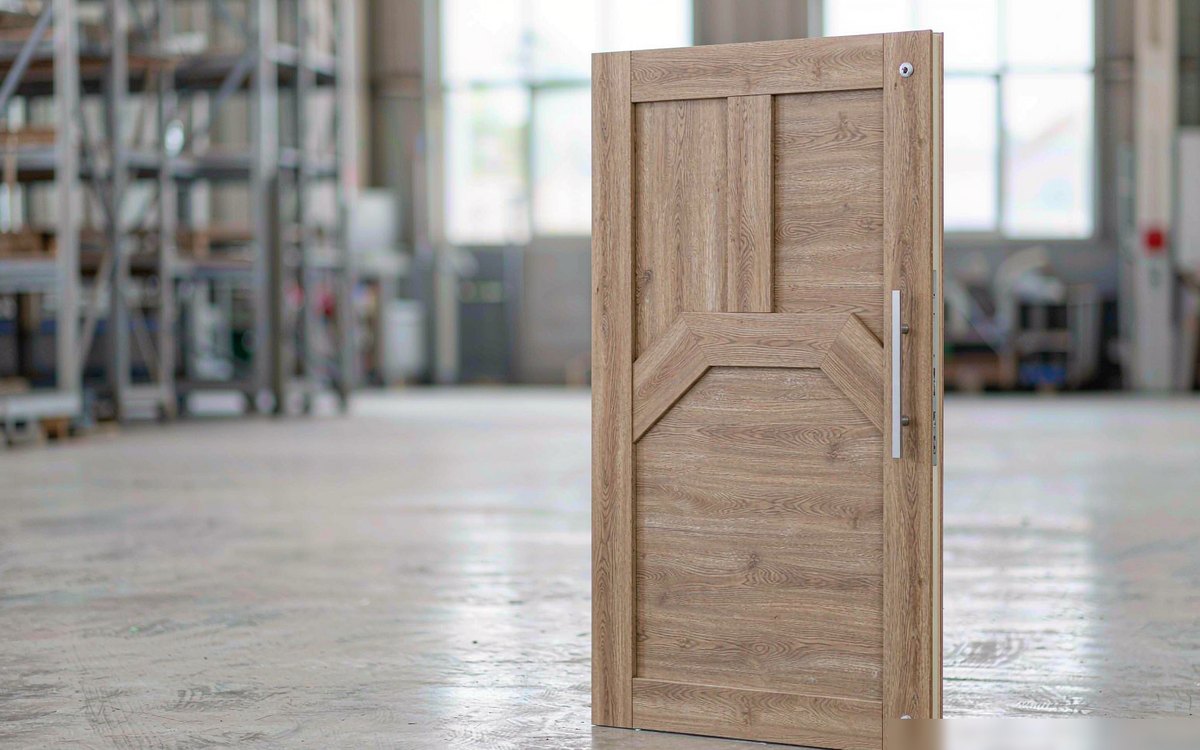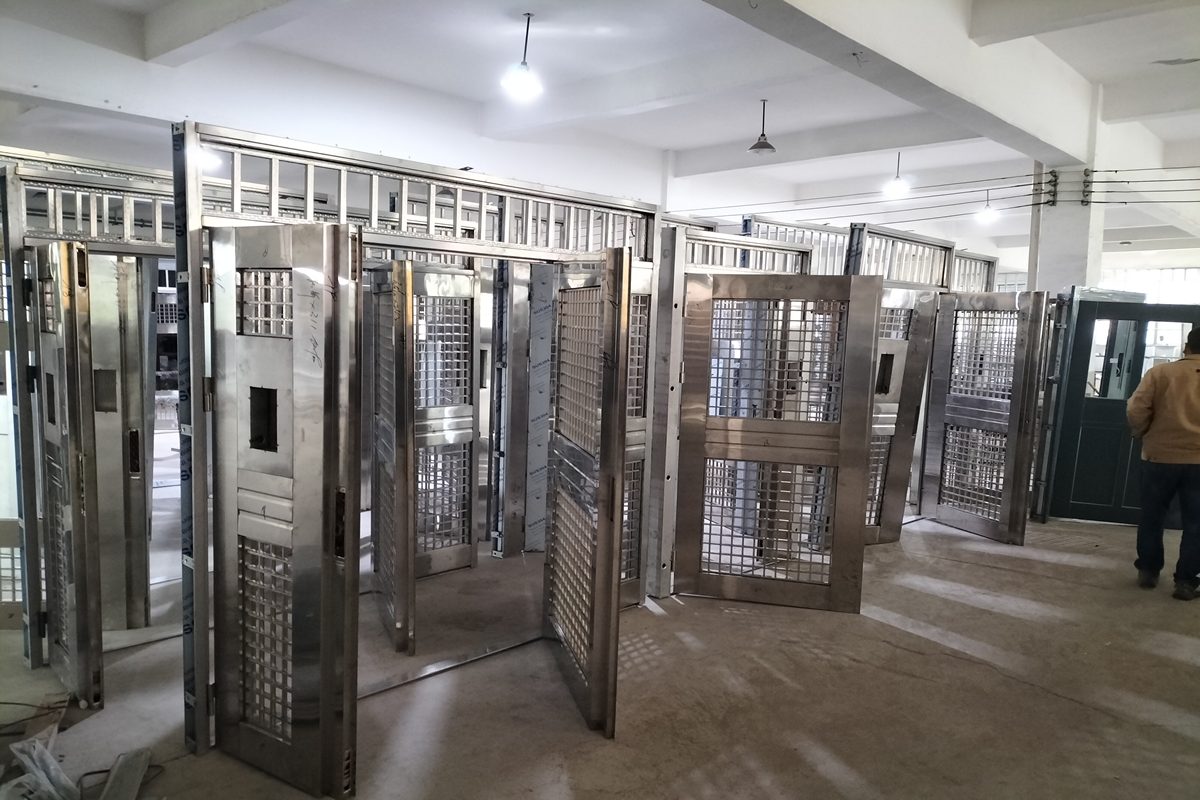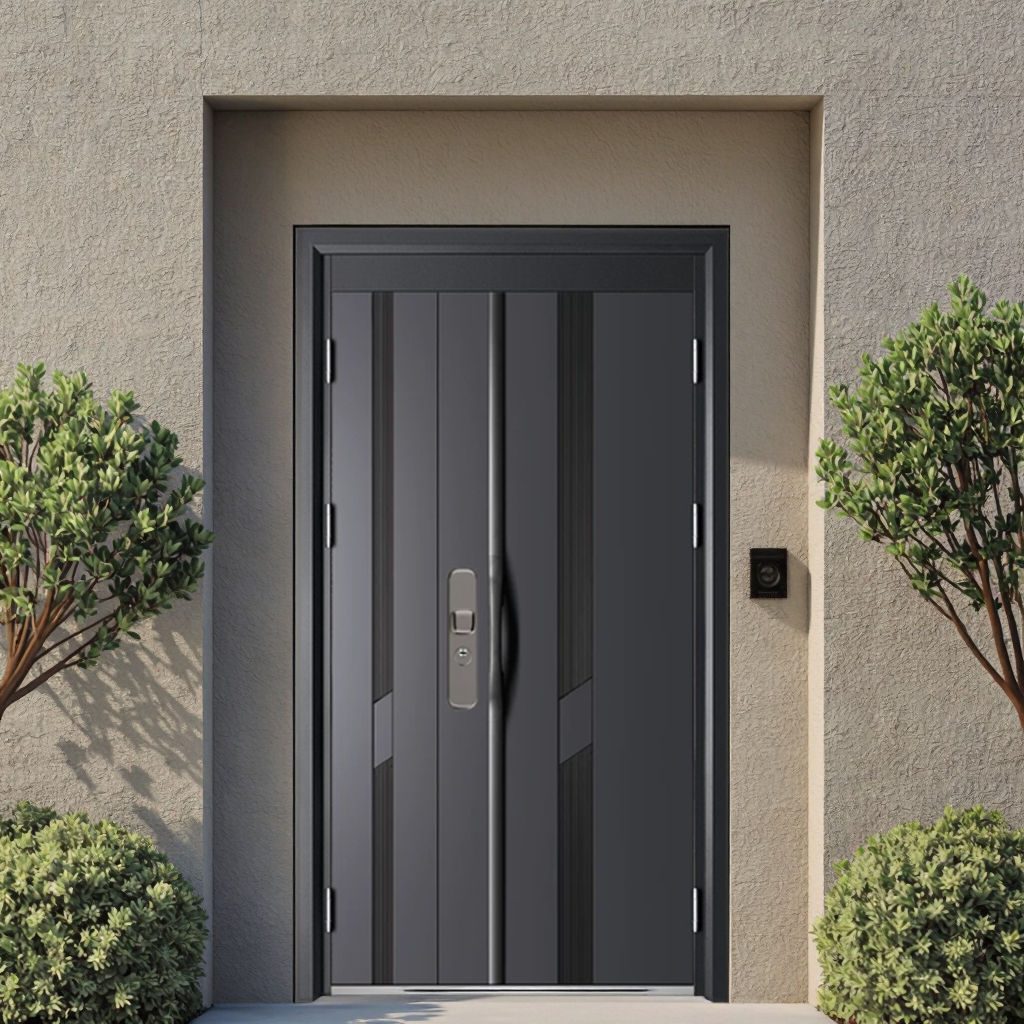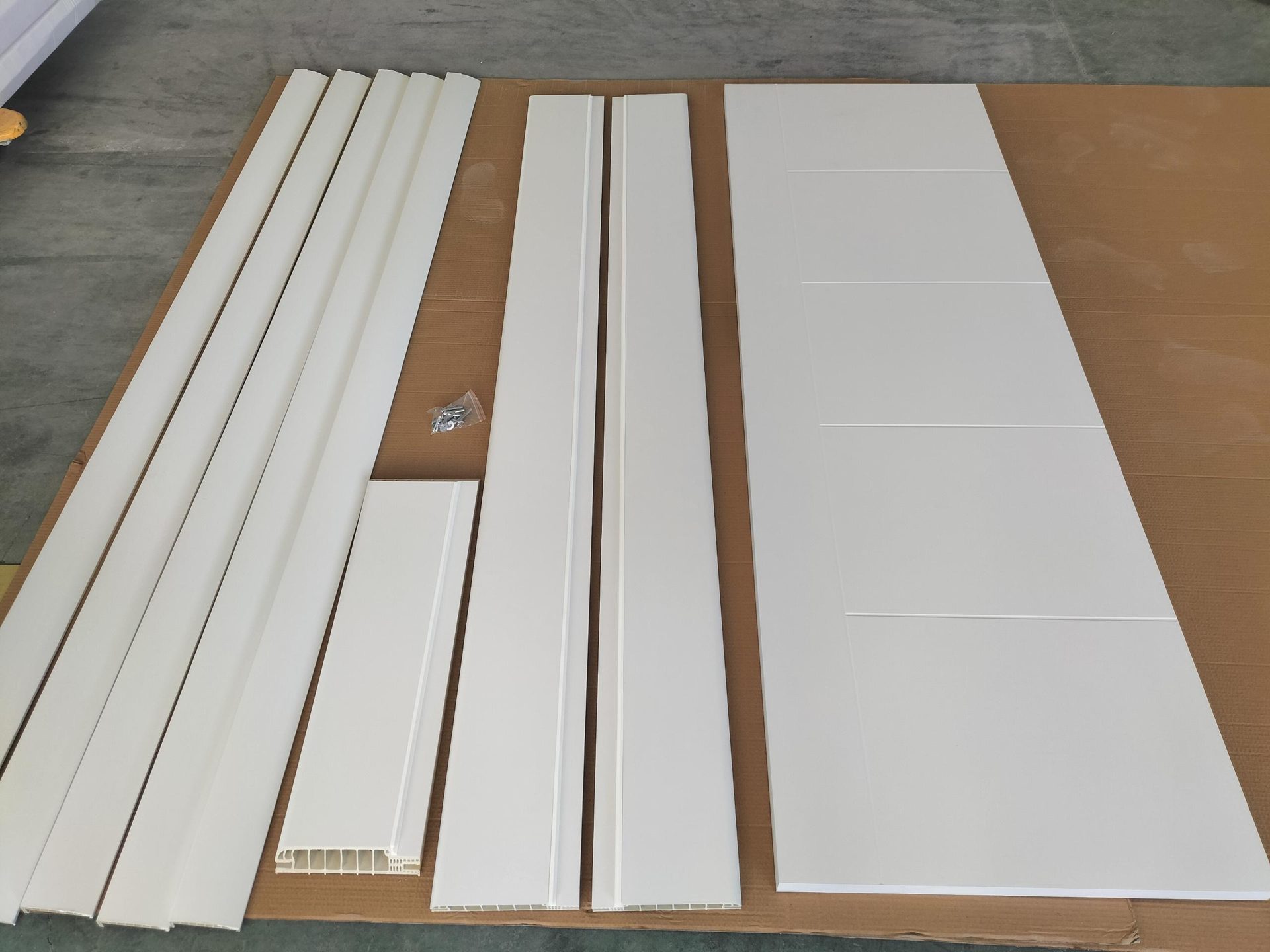
Suncity has been manufacturing doors in Yongkang, Zhejiang since 1998. We build wood-plastic composite (WPC) doors, PVC doors and wood door systems, and we ship to more than 165 countries. What follows is a plain description of what WPC doors are, how ours are built, and what to look at when you are comparing suppliers.
What a WPC door actually is
Wood-plastic composite is exactly what the name describes: wood flour and mineral filler compounded inside a polymer resin, usually PVC. The polymer encapsulates the wood fibre rather than simply coating it, which is the mechanism that gives the material its behaviour.
That encapsulation is the reason WPC handles moisture and termites well. Cellulose is what absorbs water and what termites eat; when the fibre is surrounded by polymer, there is far less of it accessible. The protection comes from how the panel is built rather than from a surface treatment that wears away. We cover the mechanism in more detail in our guide to specifying WPC doors.
Construction is where doors differ
Two doors sold as “WPC” can be built very differently, and the difference decides how they behave in service.
- A homogeneous extruded core is WPC all the way through the leaf. There is no separate core material to expose if the door is cut or trimmed, and the material behaves consistently across the whole thickness.
- A skinned construction is a WPC or PVC facing over another core material. This can be a perfectly good product, but the cut edges expose the core, so the edge sealing is doing much more of the work.
The practical consequence is that “is it WPC?” is the wrong question. The right questions are about the core, the density, the polymer fraction, and how the cut edges are sealed — particularly the bottom edge, which is where moisture damage usually starts.
What we make
We produce the full chain in-house: board, door leaf, frames, moulding, hardware and packaging. That covers:
- WPC interior doors — the main product line, for residential, hospitality and commercial interiors
- WPC doors for wet areas — bathrooms and wet rooms, where moisture resistance is the primary requirement
- PVC doors — a lower-cost option where the finish and moisture requirements suit it
- Wood door systems — including laminate, melamine and painted finishes
- Frames, architraves and hardware — supplied as a matched set with the leaf
We also produce to OEM specification, which is how most of our customers buy: their branding, their packaging, their door schedule. Because we control the board and the extrusion stage, a specification agreed on the first order can be held on repeat orders.
Where WPC doors work best
The strongest case for WPC is environments where moisture and humidity would shorten the life of a conventional wood-based door. Bathrooms, kitchens, laundries and utility rooms. Coastal and tropical buildings. Hotel and apartment projects in hot, humid markets where replacement cycles for conventional doors are short and disruptive.
They are also a sensible choice where dimensional stability matters — a door that stays flat and keeps closing properly over a decade of humidity cycling is worth more than one with a marginally better finish that swells in its second season.
Where a WPC leaf is the wrong choice
Every material has work it does well and work it does not. These are the cases where we would quote you something else from the range rather than an interior WPC leaf.
- Exterior entrances in sustained direct sun. Standard interior grades will chalk and fade unless the formulation is specifically UV-stabilised for outdoor use. If the door faces the weather, specify the outdoor grade and say so up front.
- Rated fire doors. Where a project requires a fire resistance rating measured in minutes, you need a purpose-built, tested fire door assembly, not an interior WPC leaf with a fire-retardant additive. Fire classification to EN 13501-1 or ASTM E84 describes surface spread of flame, which is a different thing from a fire resistance rating.
- Heavy industrial traffic. Where impact loads are severe, we would put forward a solid-core leaf or a steel door instead.
What to ask any supplier — including us
Whatever brand you are comparing, the same figures decide whether the product performs as claimed. Ask for each of these in writing, with the test standard named:
- Core material and density
- Water absorption, with the standard and immersion duration
- Polymer-to-wood ratio
- Surface hardness
- Formaldehyde emission class, tested to the method your market requires
- Fire classification, in the system your building code references
- Edge and bottom-rail sealing method
- Whether test reports are batch-linked or from a single sample run
A factory that controls its own board and extrusion can answer those from production data. A trader reselling someone else’s production usually cannot, and that gap is the most reliable difference between the two.
Getting a quotation that means something
To quote accurately we need the application, the destination market, the quantity, and any certification the project requires. Send those four things and we will come back with the matching specification, the data sheet, and sample availability.
Explore our WPC door range · See our core materials · About our factory