Every WPC door supplier says the same four things. One hundred percent waterproof. Termite-proof. Formaldehyde-free. Fire-retardant.
Those claims are mostly true of the material category. They tell you almost nothing about the container you are about to buy.
The difference between a WPC door that lasts fifteen years in a Jeddah bathroom and one that fails in eighteen months is not whether the supplier used the words “wood-plastic composite.” It is core density, polymer ratio, edge sealing, and whether the factory can hold those values across a production run. Those things appear on a technical data sheet. They rarely appear in a catalogue.
This is a guide to what belongs in your purchase specification, and how to check whether a supplier can actually meet it.
What WPC is, and why the mechanism matters
Wood-plastic composite doors are made by extruding wood flour and mineral filler inside a polymer resin, usually PVC. The polymer surrounds the wood fibre and seals it.
That sealing is the whole point. A solid wood or MDF door absorbs water because cellulose fibres draw moisture along capillary paths. Left in a bathroom, an MDF core can take up 10% to 30% of its weight in water over 24 hours, and the swelling that follows is what jams the lock, splits the paint, and opens the joint between leaf and frame. In WPC, the polymer matrix blocks those capillary paths. Water has no route in.
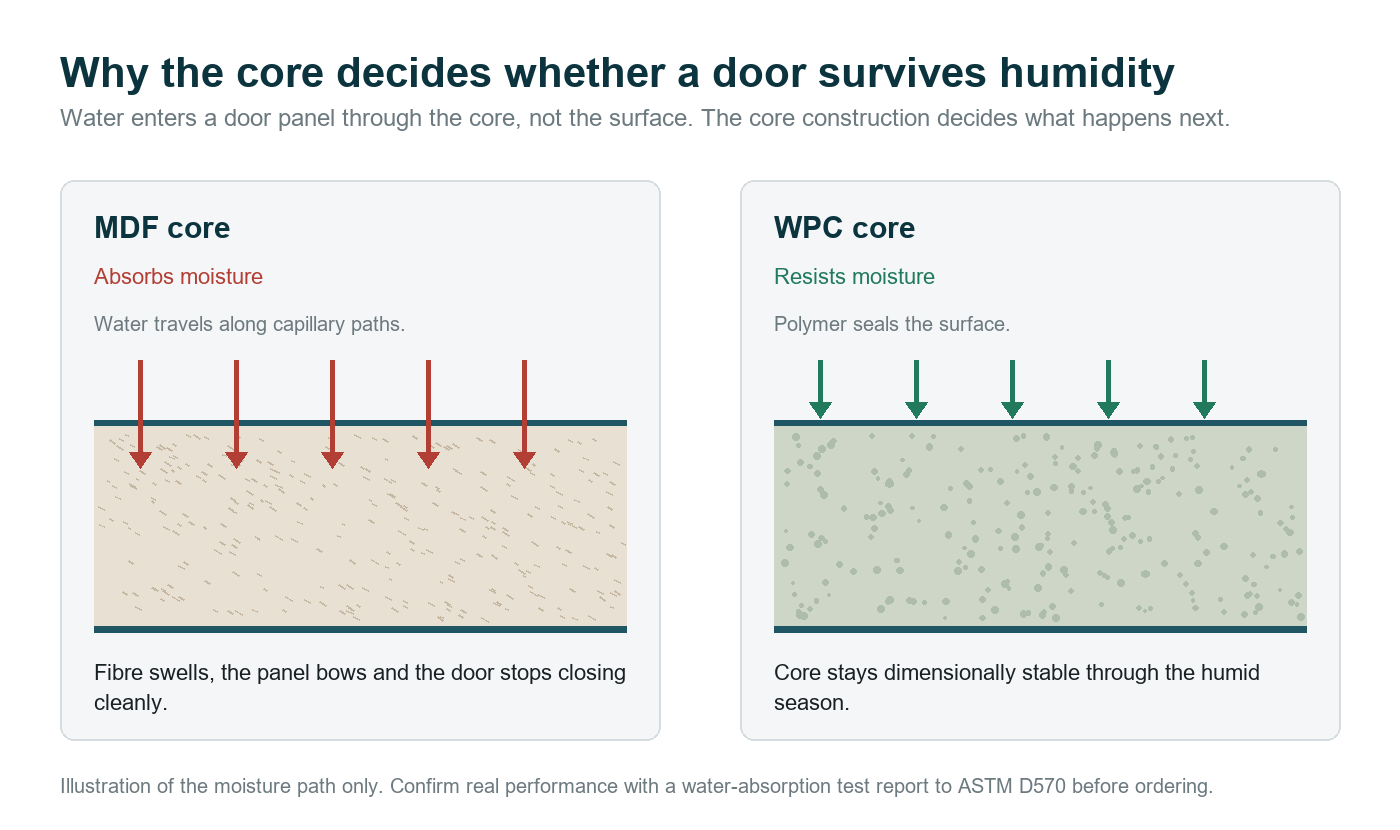
The same mechanism handles termites. Termites eat cellulose. When wood fibre is encapsulated in PVC at a high enough polymer fraction, there is no accessible cellulose to eat, so resistance comes from the material’s construction rather than from a chemical treatment that depletes over time.
This matters for your specification because the protection is proportional to how well the encapsulation is done. A door with a high polymer fraction and a properly sealed edge behaves as advertised. A door with a thin WPC skin over an untreated core has a cut edge that is an open door for moisture. Both get sold as “WPC.”
So the question to bring to a supplier is not whether the door is WPC. It is how the door is built.
Seven specifications to write into the purchase order
Ask for each of these in writing, with the test standard named. A factory running a controlled process will have them. A trading company reselling someone else’s production usually will not.
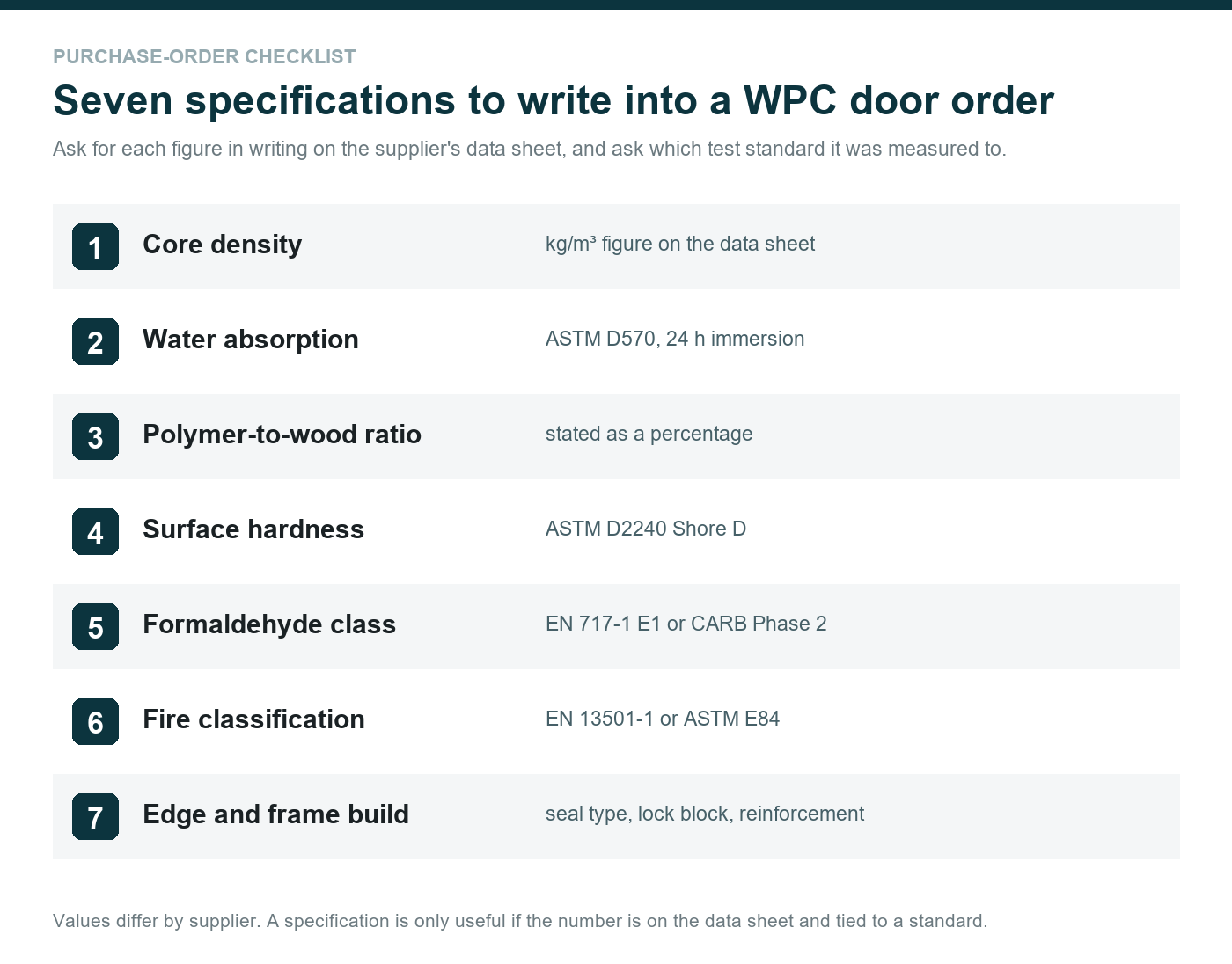
1. Core density. Typically quoted between 0.6 and 1.2 g/cm³ depending on construction and whether the core is solid, foamed, or reinforced. Density drives rigidity, acoustic mass, and screw-holding strength. A low-density foamed core is lighter and cheaper and perfectly adequate for a bedroom; it is the wrong choice for a hotel corridor with a door closer and a heavy lockset. Specify the number you need for the application rather than accepting the factory default.
2. Water absorption, 24-hour immersion. Test standard ASTM D570 or ASTM D1037. Quality WPC is commonly specified at or below 0.8% mass gain. This is the number that turns “100% waterproof” from a slogan into something measurable. Note that published figures vary across the industry depending on construction and test conditions, which is exactly why you want the supplier’s own report rather than a category average.
3. Polymer-to-wood ratio. Higher polymer fraction means better moisture and termite resistance and higher cost. Lower fraction means cheaper and heavier on wood content. Suppliers quote anywhere from roughly 45:55 to 70:30. There is no universally correct ratio, but there is a correct answer for your climate and price point, and you should know which one you are buying.
4. Surface hardness. Shore D, tested to ASTM D2240, commonly in the 72 to 82 range for door-grade WPC. This predicts how the surface holds up to trolleys, luggage, cleaning equipment, and general abuse. It matters more in hospitality and healthcare than in residential.
5. Formaldehyde emission class. Covered in detail in the next section, because it contains the most common and most expensive misunderstanding in the category.
6. Fire classification. EN 13501-1 (the European Euroclass system, where B-s2,d0 is a common result for interior WPC) or ASTM E84 for North American work. Check which system your destination market’s building code actually references. A Euroclass certificate does not satisfy a jurisdiction that asks for ASTM, and vice versa. For hospital, hotel, and school projects this is usually a pass-or-fail item in the tender, not a preference.
7. Edge and frame construction. The least glamorous item and the most common failure point. Ask how the bottom edge is sealed, what the frame is made of, and whether the lock block is integrated into the core. A door leaf with excellent laboratory numbers and an unsealed bottom edge will still fail in a wet room, because the water goes in through the cut face that the test panel never had.
The formaldehyde trap that catches experienced buyers
Formaldehyde is classified by IARC as a Group 1A carcinogen, and chronic exposure above 0.1 ppm is associated with meaningfully higher nasal cancer risk. That is why emission classes exist and why regulators keep tightening them.
The classes themselves are straightforward:
| Class | Chamber limit | Typical use |
|---|---|---|
| E2 | 0.124–0.3 mg/m³ | Withdrawn from indoor use in China under GB/T 39600-2021 |
| E1 | ≤0.124 mg/m³ | The accepted EU indoor baseline |
| E0 | ≤0.05 mg/m³ | Premium: schools, hospitals, children’s rooms |
| CARB Phase 2 | ~0.05 ppm (hardwood plywood) | Mandatory for the US market |
| NAF | <0.025 mg/m³ | No urea-formaldehyde resin used at all |
Here is where buyers lose money. An E1 certificate issued under EN 717-1 does not prove CARB Phase 2 compliance. The two use different test methods. EN 717-1 measures a seven-day chamber average at lower airflow and captures the initial emission spike, which occurs in the first 24 to 72 hours and accounts for the large majority of total off-gassing. ASTM D6007, used for CARB, runs continuous cycles at higher airflow that spread the measurement out. The same physical panel can be graded differently by the two methods, and reclassification between them is common enough that you cannot assume equivalence.
If your container is going to the United States, ask for a CARB Phase 2 or TSCA Title VI certificate specifically, from a third-party certifier, with the test method printed on it. A European certificate and a confident sales email are not the same thing as market access.
One more note that helps in this category: doors built on a genuine WPC core sidestep much of the problem, because the formaldehyde in a conventional door comes mostly from urea-formaldehyde resin in the board core. Where there is no UF-bonded board, there is little to emit. But verify it rather than assuming it. Some doors described as WPC are a WPC skin over a conventional board core, and that core still carries the resin.
Reading a supplier’s claims
A few practical filters.
“One hundred percent waterproof” is a category claim, not a measurement. Accept it only alongside a water absorption figure with a test standard and a duration. The honest version is “near-zero absorption,” and a supplier who says that is usually the one who has actually run the test.
Performance tables with no test conditions. If a table lists density, hardness, and absorption but names no standard, no duration, and no laboratory, treat it as marketing. Anyone can put numbers in a table.
Figures that contradict the rest of the market. If one supplier claims performance far outside the ranges in this article, that is worth a direct question. Sometimes there is a real engineering reason. Sometimes the number was copied from a competitor’s brochure.
No batch traceability. Ask whether test reports are batch-linked or whether you are being shown a single certificate from a sample run three years ago. Consistency across a production run is the actual thing you are buying, and it is what separates a factory from a trader.
Regional considerations
Middle East. The dominant stresses are heat, dry-to-humid swings between air-conditioned interiors and outdoor conditions, and coastal salt air in the Gulf. Dimensional stability across temperature cycling matters as much as water resistance here. For villa and hotel work, confirm surface hardness and UV behaviour if any door sees direct sun through glazing. Fire certification is usually explicit in project specifications.
Southeast Asia. Sustained high humidity, often 70% to 90% year-round, plus serious termite pressure. This is where WPC has its clearest advantage over solid wood and MDF, and where the cost of getting it wrong is highest, because replacement cycles for conventional doors can be as short as three to eight years in wet rooms. Prioritise polymer ratio and edge sealing.
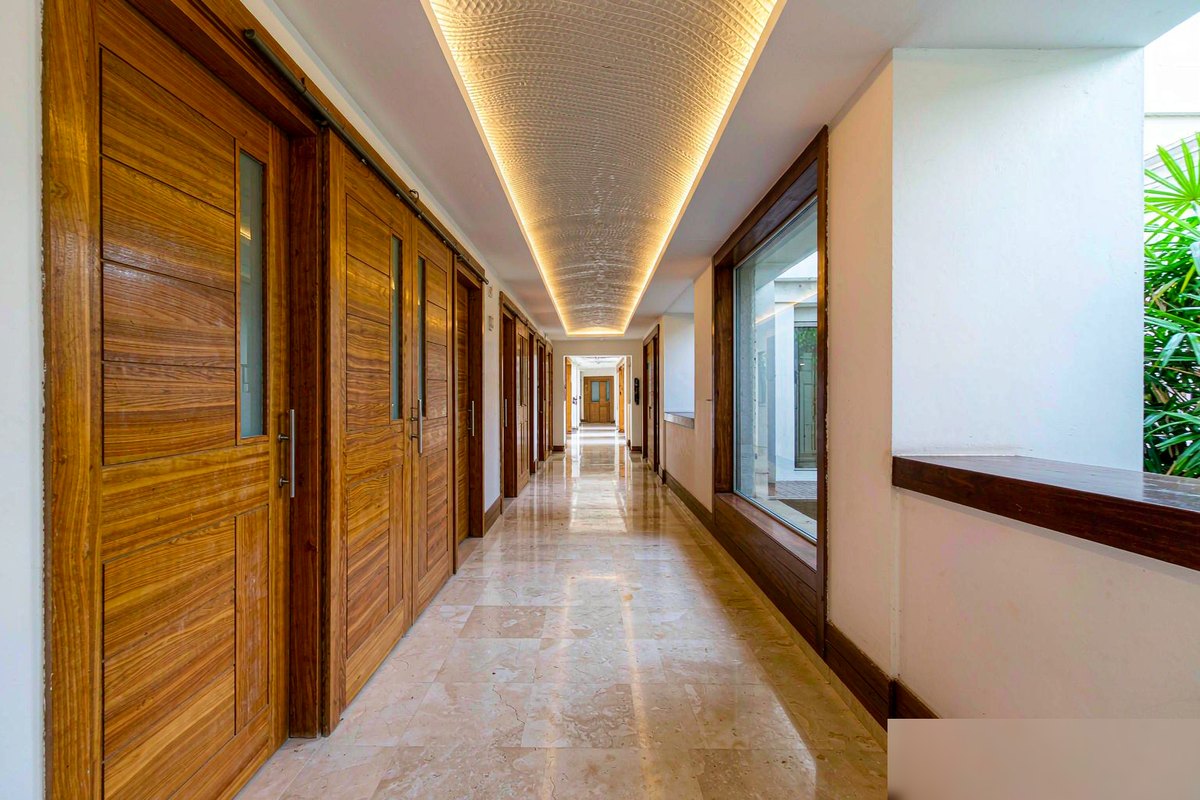
South America. Tropical and coastal conditions across Brazil, Colombia, Peru, and Ecuador create the same moisture and mould problems, with the added factor that many buildings have non-air-conditioned corridors where humidity is uncontrolled. Buyers in these markets often also want a convincing wood-grain appearance, so surface finish quality and colour consistency across batches become commercial requirements, not just aesthetic ones.
Where WPC is the wrong answer
A supplier who will not tell you this is not being straight with you.
WPC interior doors are not the right product for exterior entrances in sustained direct sun unless the formulation is specifically UV-stabilised for outdoor use. Standard interior grades will chalk and fade.
They are not the strongest option for heavy industrial traffic, where impact resistance requirements can exceed what a standard WPC leaf provides.
And where a project demands a specific fire-resistance rating measured in minutes rather than a surface-spread classification, you need a purpose-built fire-rated door assembly tested as a complete unit, not an interior WPC leaf with a fire-retardant additive.
Matching the product to the application is cheaper than warranty claims.
Before you order
A short checklist that prevents most problems:
- Request the full technical data sheet with test standards named for every figure
- Confirm the emission certificate matches your destination market’s test method
- Confirm the fire classification system matches the local building code
- Order physical samples and check the bottom edge seal and lock block yourself
- Ask how many production lines make this SKU and whether test reports are batch-linked
- Confirm packaging specification for sea freight, including moisture protection in transit
- Agree the inspection standard and who performs it before the container ships
- Clarify lead time for stocked items versus custom production, and what triggers the difference
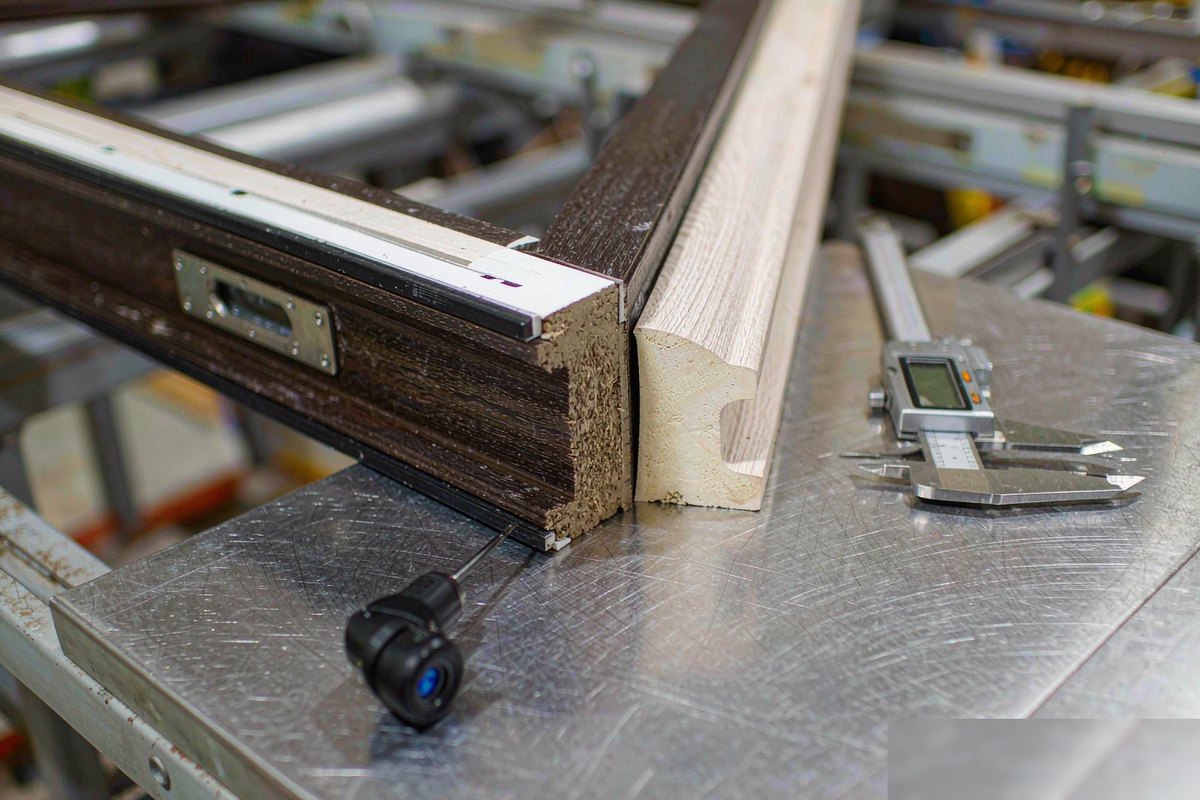
Samples are the step buyers skip when they are in a hurry. Cut a sample door in half. The cross-section tells you more about the factory than any certificate.
Why the factory structure matters
One last point that is easy to overlook when comparing quotations.
Most of the specifications above are core properties. Density, polymer ratio, emission class, and edge construction are all determined at the board and extrusion stage, before anyone assembles a door. A supplier who buys finished door leaves and adds hardware cannot control any of them. They can only pass along whatever their own supplier delivered, and when a batch varies, they find out when you do.
At SunCity, we produce the full chain in-house: raw board, door leaf, frames, molding, hardware, and packaging. We have been manufacturing doors in Yongkang since 1998, and we currently ship to customers in more than 165 countries across a range of 3000+ SKUs. That structure is the reason we can answer specification questions with production data rather than a supplier’s brochure, and it is the reason OEM customers can hold a consistent standard across repeat orders.
Whether you buy from us or from someone else, ask the questions in this article. A factory that controls its own core will welcome them.
Next step: Send us your application, target market, and volume, and we will send the technical data sheet for the matching WPC specification along with sample availability. If you are comparing suppliers, bring the checklist above to all of them.
Explore our WPC door range · See our core materials · About our factory